|
|
Acridium
emarginatum Uhler,
manuscript
|
-
|
|
Acridium
emarginatum, nomen nudum Dodge,
1872: 15
|
Acridium
emarginatum Scudder, 1872: 250 
|
|
Schistocerca
lineata Scudder, 1899: 465
|
|
Schistocerca
scudderi Bruner, 1906: 676, unnecessary replacement name
|
|
Schistocerca
lineata Scudder (Hubbell, 1960: 71)
|
|
Schistocerca
emarginata (Scudder) (Vickery and Kevan,
1964: 1555; 1983: 725)
|
|
Schistocerca
alutacea lineata
(Scudder) (Dirsh, 1974: 204)
|
|
 |
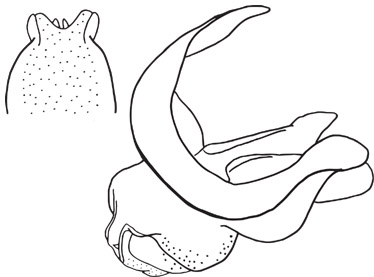
| Cingulum,
surfaces or rami not infolded and sinuate, thus making "basal
eminence" appear hour-glass shaped, and broad in the middle |
|
|
|
|
 |
| Schistocerca
lineata is abundant in sandy areas, but also
frequently found in other habitats.
Detailed account of its habitat association is found in Hubbell
(1960: 43-48). Criddle
(1932) reported that the development takes 39 days from the time of
hatching. He also noted
that this species has five nymphal instars.
Sword and Dopman (1999) suggested that the nymphal instars in
Texas populations behave as monophagous while the adult instars are
polyphagous. Dopman et
al. (2002) found that the populations associated with either Ptelea
or Rubus form a monophyletic clade using 16S rRNA and 12S rRNA
regions of the mitochondrial DNA.
Although their study demonstrated the lack of gene flow between
two host-associated populations, I am hesitant to create a new
taxonomic concept at this moment because not much is known about the
populations in the midwestern and eastern U.S.
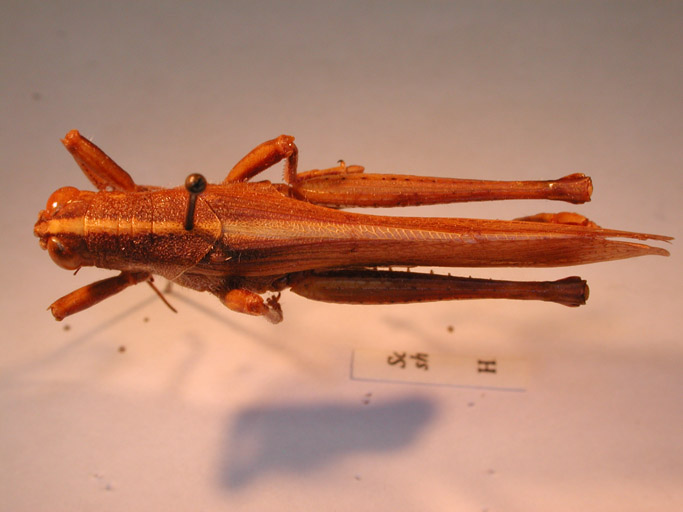
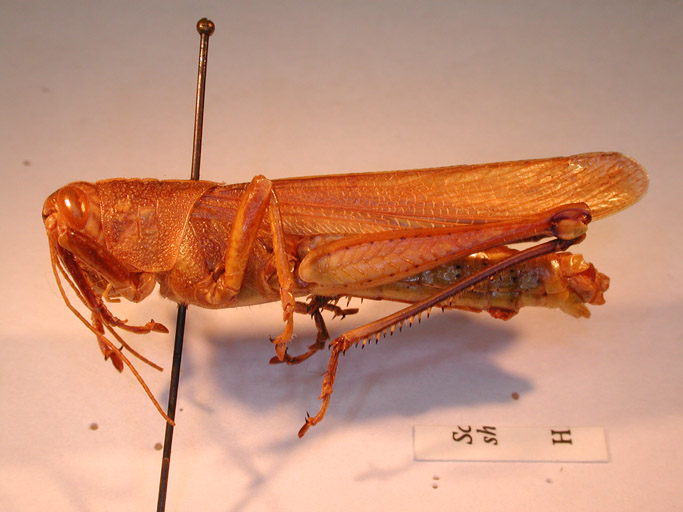
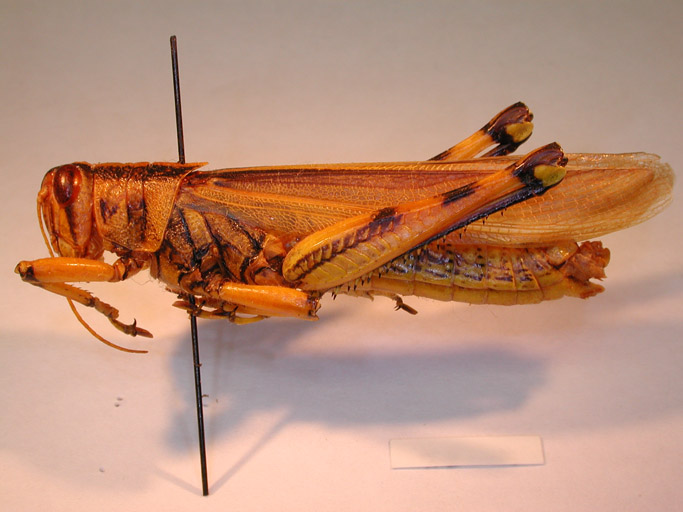
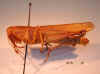
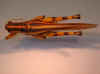
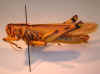
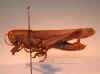
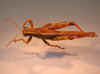
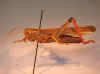
Highly conspicuous individuals from the southwestern states are
more robust in form and slightly larger than non-conspicuous ones.
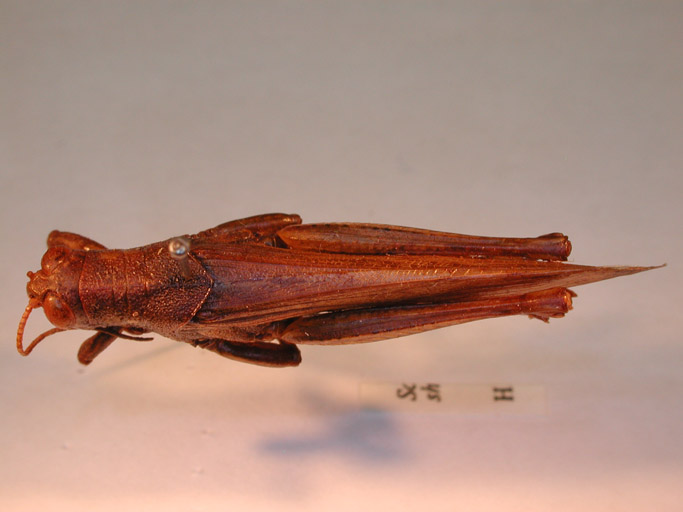
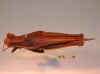
In terms of coloration, specimens from Great Lake regions are
brown and highly resemble S. rubiginosa.
Aposematic specimens are never found in northern states
although the polymorphism of dorsal longitudinal stripe exists.
In western states, specimens become almost indistinguishable
from S. shoshone except on the basis of markings on abdominal
tergites. These specimens
have olive green hue, which is rarely observed in either southwestern
or eastern populations. In
all cases, however, crucial morphological characters, such as phallic
complex and inflated male femurs, are identical.
The reason S. lineata is so polymorphic is unknown, but
the fact that it is most widespread seems to suggest that the species
is adaptively highly plastic. |
|

|
|
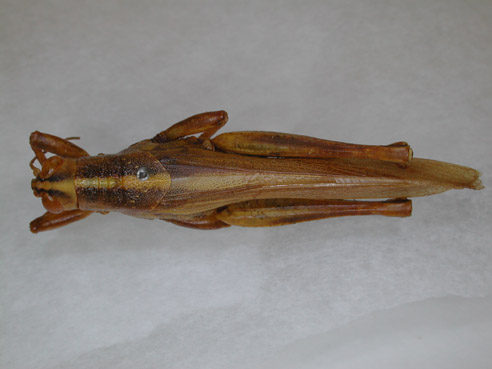
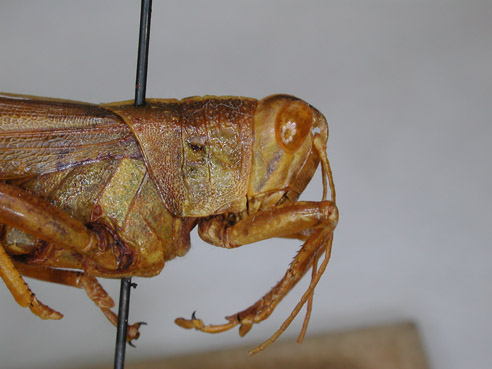
Typical form (found in eastern U.S.)
|

|
|
|
|
Aposematic form (found in southwestern
U.S. including TX and OK)
|
|
|
|
|
Brown form (found in Great Lake regions)
|
|
|
|
|
Olive green form (found in western U.S.
including UT and CO)
|
|
|
|
|
 |
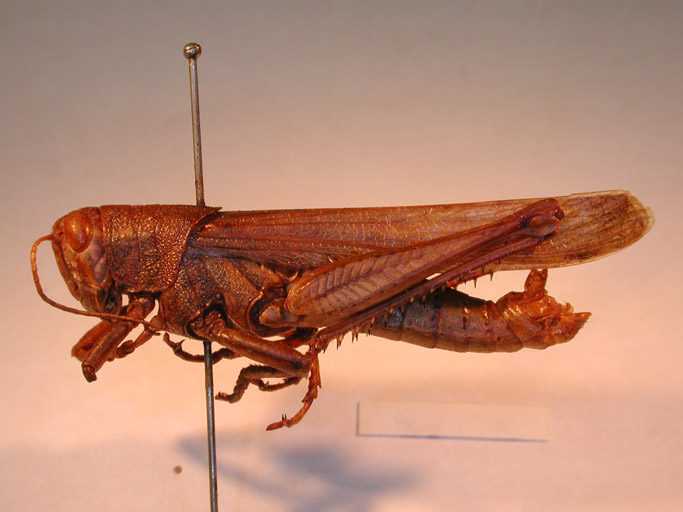
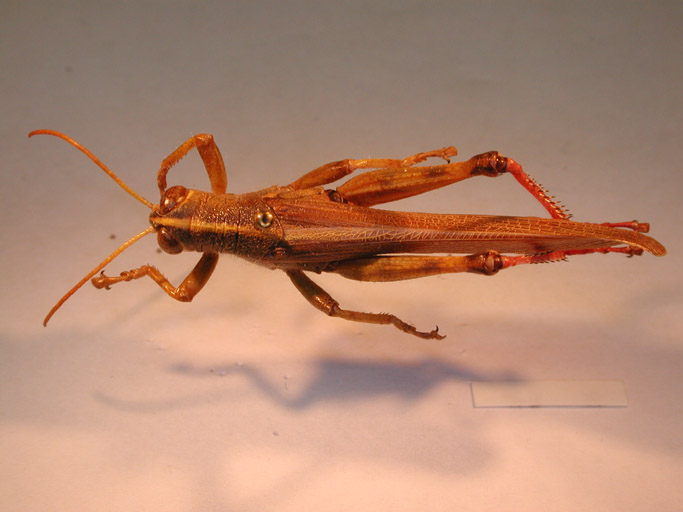
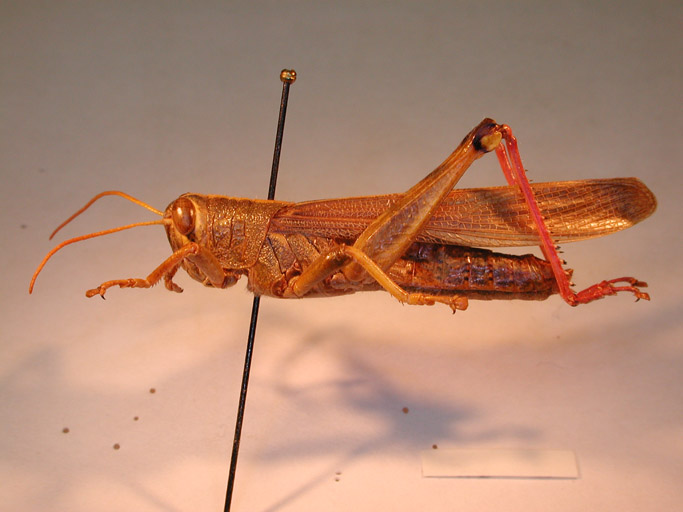
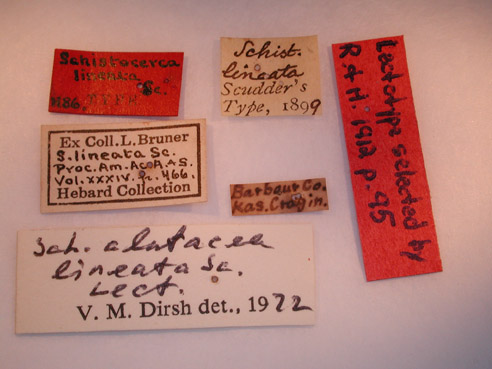
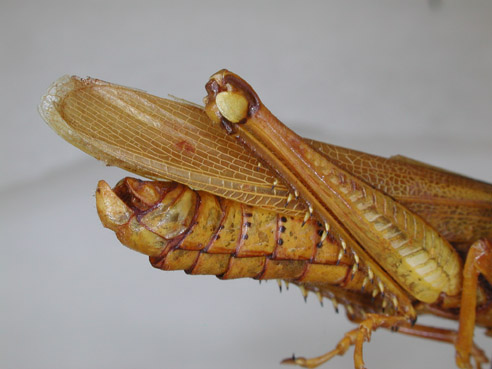
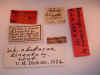
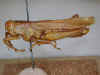
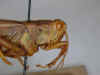
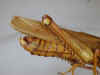
| LECTOTYPE
♂ [ANSP] Schistocerca lineata Scudder, 1899 |
 |
 |
 |
 |
 |
|
|